Recycling in a small apartment competes with groceries, dishes, and the space needed to move around. A useful setup does not have to be a row of large matching bins. It needs to hold the materials you actually generate and make the trip to their next destination straightforward.
Observe several ordinary days before buying containers. Note where paper, packages, and bottles accumulate, how often each stream is emptied, and what makes the current arrangement awkward. A bin can have enough capacity but still fail because it is blocked by other objects or too heavy to carry when full.
Work backward from collection
Check the services available at your address, including your building's rules and the local provider's accepted materials. Do not assume that a general city list describes every private hauler or apartment arrangement. Establish whether glass goes in the main recycling stream, needs a separate drop-off, or is not collected there.
A daily trip past the building's containers may allow a very small kitchen collection. A less frequent drop-off route may need more storage, but the container still has to be manageable when full. Try lifting an appropriate sample load before committing to a deep tub. Plan transport at the same time as storage so you do not have to empty everything into another bag later.
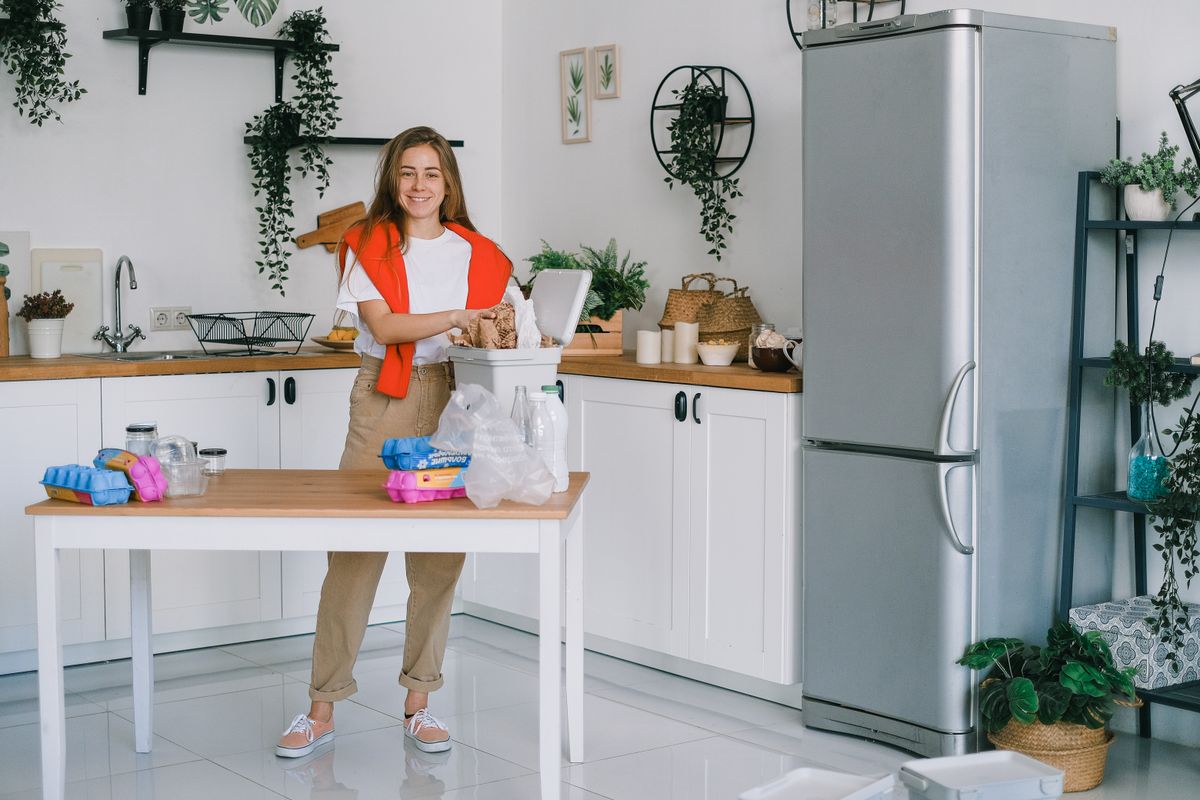
Different streams can live in different places. Clean paper may belong near the desk, returnable containers near shopping bags, and ordinary kitchen packaging near the counter where it is emptied. Batteries and other items with special handling requirements need a separate suitable arrangement, not an open miscellaneous box under the sink.
Measure how the space works
Check door movement, drawer clearance, pipework, and access to handles. A container may technically fit inside a cabinet while being difficult to remove. A tall bin under a low counter can obstruct the opening used for everyday items. Test existing containers before ordering a new set.
Keep exits and walking routes clear. Avoid a stack that can fall when a door opens or a heavy glass container on an unstable shelf. If the available spot is awkward, smaller loads emptied more often may work better than squeezing in a larger unit.
Make the routine shared
Label the actual stream with a few common examples and an important exclusion. Color can help, but should not carry the whole explanation. A visitor or housemate should be able to understand the setup without memorizing a local color convention.
- Agree on when a temporary container is considered full.
- Keep the bags or crates needed for transport nearby.
- Leave enough access for cleaning and removing spills.
- Give uncertain items a short review process rather than a permanent pile.
After two weeks, look at what still ends up on the counter. If the same package is repeatedly left out, the issue may be an unclear rule or an inconvenient opening. Adjust that specific problem instead of rebuilding the whole system.
Judge the result by whether materials reach the correct destination and the apartment remains usable. A visually tidy row of bins is not the only successful arrangement. A lighter carry crate, a better label, or a shorter emptying interval may improve daily use more than another purchase.