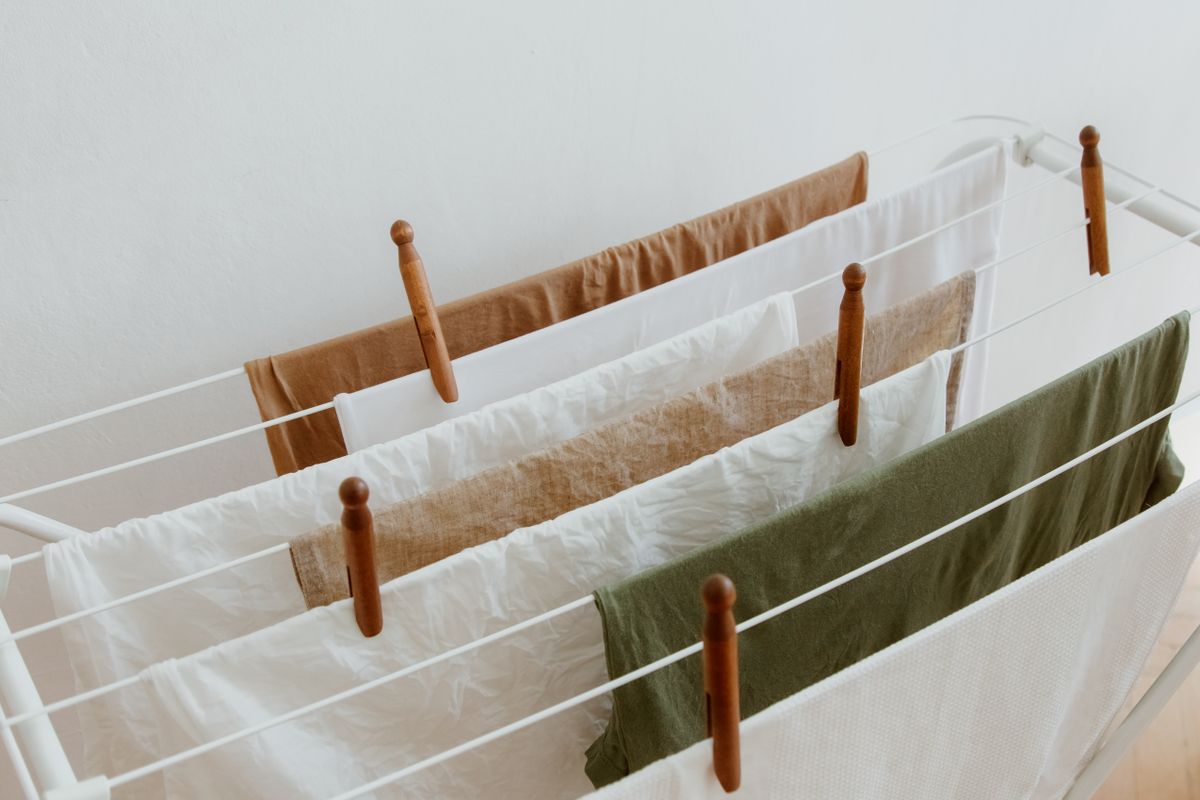
A drying rack is not being used well merely because every gap is filled with fabric. Closely touching garments can restrict air movement and remain damp where they overlap. Plan around the space clothing needs while drying, not just the total length of available rails.
Prepare the load for its drying method
Start with the garment care instructions. Some items need flat drying while others can hang. Use only a spin setting appropriate for the fabric during washing. A stronger spin is not a universal answer for every delicate garment.
Gently straighten suitable items and untangle sleeves or pant legs. Distribute heavy pieces so the rack stays stable. Long fabric should not rest on the floor or touch heating equipment. Leave gaps between garments and, where helpful, spread a thick item over more than one rail to avoid tightly packed wet layers.
Account for moisture in the room
Consider an appropriate outdoor location when available and permitted. For indoor drying, pay attention to ventilation and humidity. EPA recommends keeping indoor relative humidity below 60 percent, ideally between 30 and 50 percent where possible, as part of moisture control. A rack that looks orderly can still add substantial moisture to a small closed room.
Do not position wet laundry tightly against a cold wall or in a stagnant corner. Keep doors, walking routes, and required clearances around heat sources unobstructed. A humidity monitor can help reveal a change while laundry dries. Recurring condensation, musty odors, or visible damp damage call for investigating the moisture source rather than covering the smell.
Avoid assuming a fixed drying time. A thick towel and a thin shirt behave differently, and conditions change. Check cuffs, pockets, seams, and layered areas before folding. The outside can feel dry while a hidden section remains damp.
Plan the following load too
Remove dry pieces when practical and give remaining damp items more room. Do not automatically start another large load before appropriate drying space is available. Changing the order of laundry may solve the bottleneck without distributing additional racks throughout the home.
Clean the rack occasionally and inspect contact points for rust, sharp edges, or residue. A simple clean, stable drying area is more useful than the maximum possible number of crowded rails. Good garment care and moisture management are parts of the same process, especially when the living space also serves as the laundry area.